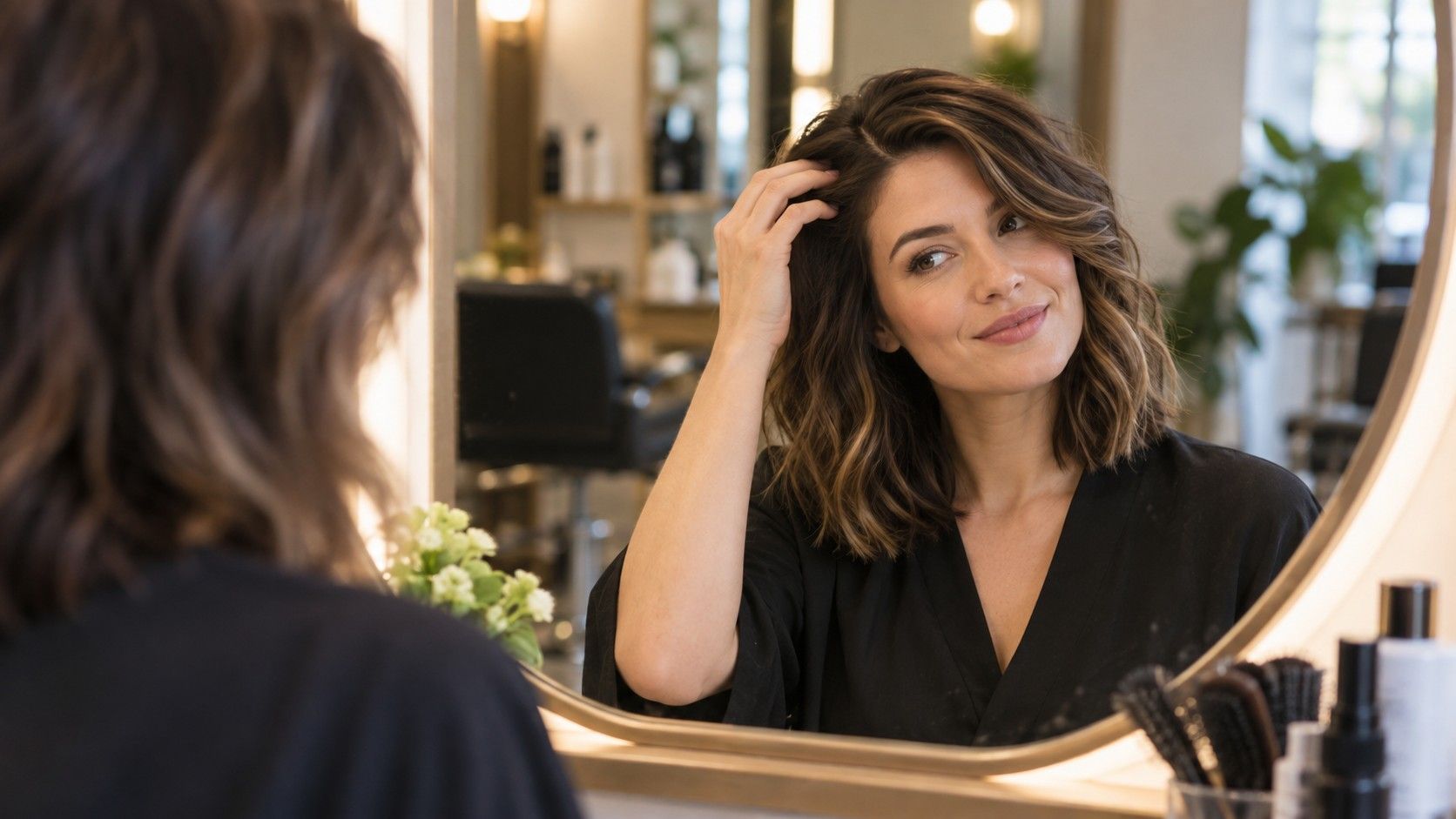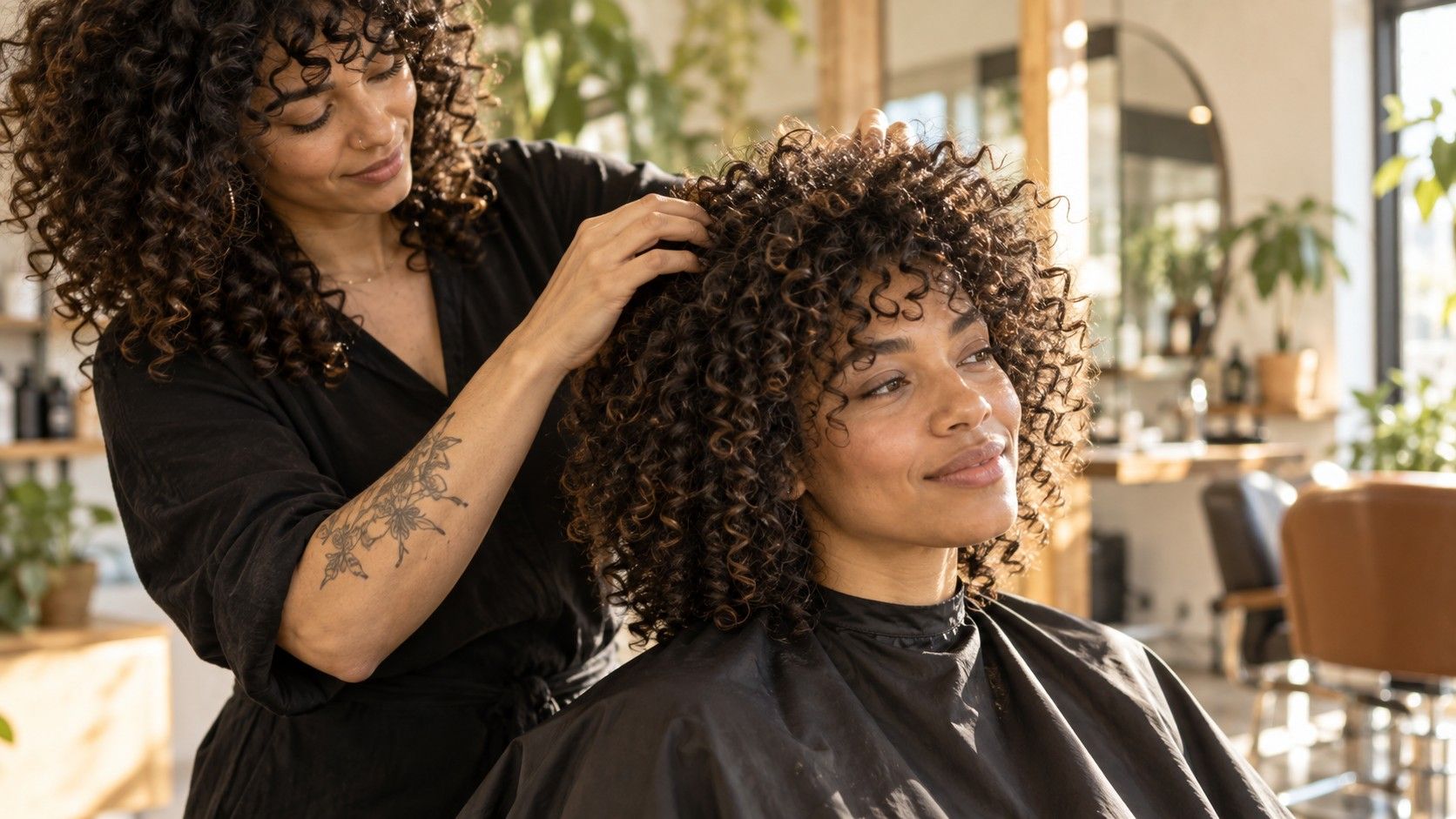
A good curly cut is less about finding one perfect reference photo and more about predicting how your own hair will behave when it is dry, moving, and a few days past wash day. Curl pattern, density, shrinkage, and the way you normally part your hair all change the result. The most useful haircuts for curly hair leave room for that reality instead of trying to make every curl sit in the same place.
Why the dry shape matters more than a wet outline
Curly hair can look evenly distributed when it is saturated, combed, and pulled straight by water. Once it dries, individual curl clumps spring up at different rates. A section at the crown may sit two inches shorter than a section near the nape even when both were cut to the same wet length. That is why a dry cut, or at least a cut that is repeatedly checked dry, gives a stylist much better information about the final silhouette.
Watch where your hair naturally separates before an appointment. Some people have a strong off-center part that creates more height on one side; others get a flat crown and fuller temples. Bring your hair in its usual state rather than heavily stretched, slicked back, or pressed into a new part for the day. A stylist needs to see the curl clumps you live with, including the pieces that flip outward or shrink more than the rest.
Dry cutting does not mean every curl must be cut one by one without a plan. The perimeter still needs balance, and interior sections need enough connection that the hair can move as one shape. The practical advantage is that length decisions happen with the finished texture visible. If you prefer a wet cut, ask for a dry review before you leave and leave enough time for small adjustments after the hair has been diffused or air-dried.
Understand shrinkage before choosing a length
Shrinkage is simply the difference between the length you can see when a curl is stretched and the length it occupies once dry. It can be modest on loose S-waves and dramatic on tight coils. It also changes with humidity, product hold, and whether the hair has been brushed out. A collarbone reference photo can therefore become a shoulder-length result, while a chin-length plan can rise high enough to expose more jaw and neck than expected.
Start the conversation with landmarks rather than only inches. Say whether you want the front to fall above the cheekbone, around the jaw, or below the chin when dry. Point out the shortest area you can tolerate at the crown and the longest point you want at the back. These markers are easier to judge during a curly cut than a number measured from a wet strand. If you are making a major change, keeping the first cut slightly longer is usually easier to live with than trying to grow back an unexpectedly short springy layer.
| What you see in the mirror | Useful cutting decision |
|---|---|
| Curls spring up strongly at the crown | Keep crown layers conservative and assess them dry |
| Front pieces shrink more than the back | Choose face-framing length by the dry position |
| Hair expands after day two | Leave room for volume instead of removing all bulk |
| Loose waves stretch easily | Check the perimeter with the natural wave restored |
Layers, weight, and the triangle effect
Layers are not automatically the answer to every curly haircut. They can release weight, encourage curl movement, and stop the lower half from forming a heavy block. But short layers added without considering density may create a wide, rounded shape: flat at the roots, broad through the sides, and narrow at the ends. This is often called the triangle effect. It is not caused by curls being wrong; it is usually a balance problem between the crown, the interior, and the perimeter.
Fine or low-density curls often need a stronger perimeter to look substantial. In that case, long, subtle internal layers may be more useful than many short visible steps. Dense curls can carry more layering, but the layers still need a clear destination. Ask whether the goal is to remove weight, build height, create face framing, or simply make the ends move. Those are different jobs, and the best haircut for curly hair does not have to perform all of them at once.
Be cautious with thinning shears when frizz is already your main complaint. Randomly shortened hairs can interrupt a curl clump and make the surface look fuzzy as it grows out. Texturizing can be appropriate in a very dense area, but it should be targeted, not used as a default substitute for shape. A cleaner internal layer and an intentional perimeter often give a softer result than aggressively taking bulk from every section.
Face framing should follow your curl behavior
Face-framing pieces can make a curly style feel lighter without changing the entire haircut, but they need to be tested where they will actually land. A curl beside the cheek can lift toward the eye when it dries, while another may stretch across the jaw. Instead of requesting a generic curtain fringe, decide whether you want softness at the cheekbone, more openness around the eyes, or a longer piece that can tuck behind the ear. Those choices affect daily comfort as much as the photo result.
Bang decisions deserve an especially honest routine check. Curly bangs usually need a quick reset in the morning because they pick up sleeping creases, steam, and humidity faster than the rest of the hair. That can be a pleasant five-minute ritual if you already refresh your curls, but it can become annoying if you normally leave the house with minimal styling. A longer first version gives you the option to pin it back while you learn how it behaves.
For curly hairstyle ideas, compare photos with similar density and curl size rather than copying only face shape. A rounded cut on loose waves and the same outline on springy ringlets may need completely different internal architecture. Bring two or three examples that show the amount of volume you like, then explain which part matters: the airy crown, the soft jawline, the defined ends, or the ability to tie it back.
How to prepare for a curly-hair appointment
Arrive with clean hair and minimal heavy buildup unless the salon specifically asks for something else. A dense layer of oil, dry shampoo, or a crunchy cast can hide how the curl pattern groups. If you normally use leave-in conditioner, gel, and a diffuser, tell the stylist; the routine explains whether the haircut will be evaluated with definition, softness, or a mix of both. Mention any areas you always clip, tuck, or avoid touching because they shrink or frizz easily.
Before the first snip, agree on a check-in point. For example, decide that the stylist will dry and reassess after the perimeter is set, before taking more length from the crown or fringe. This is useful when you are changing from a blunt cut to layers, recovering from uneven growth, or trying to preserve enough length for a ponytail. It turns a vague request for a change into a series of visible decisions.
Use direct language about maintenance. Say if you are willing to diffuse, if you prefer air drying, and how often you can return for shaping. A sculpted short curly cut may look excellent with a six-to-eight-week trim schedule, while longer layers can be more forgiving for someone who books fewer appointments. Neither choice is more correct; the right one is the version that still works on an ordinary weekday.
A realistic routine after the cut
The first wash after a new cut is the real test. Style it with your familiar products before buying anything new, so you can see what the shape itself changed. Apply product in sections if that is already part of your routine, encourage curl clumps with your hands, and let the hair dry without constantly separating it. Once it is fully dry, gently break any firm cast instead of brushing through the whole head. That preserves definition while letting the layers move.
Refresh days reveal whether the cut supports your life. A light mist of water, a small amount of leave-in, and a few minutes with a diffuser may be enough for some curl patterns. Others need only to reshape the face-framing pieces. If the back always becomes bulky, photograph it before your next appointment; a clear photo of the problem area is more useful than trying to describe it from memory. Humidity may alter the volume, but a workable cut should still have a recognizable outline when the weather changes.
Give yourself two or three wash cycles before judging the haircut. New layers can feel unfamiliar because your hands reach for the old shape, and a different perimeter may change where you apply product. If one curl sits far shorter or a side consistently feels heavy, book a small correction rather than attempting to trim it at home. The strongest curly haircuts are adjusted around the way your hair repeatedly behaves, not around a single perfect salon-day finish.